
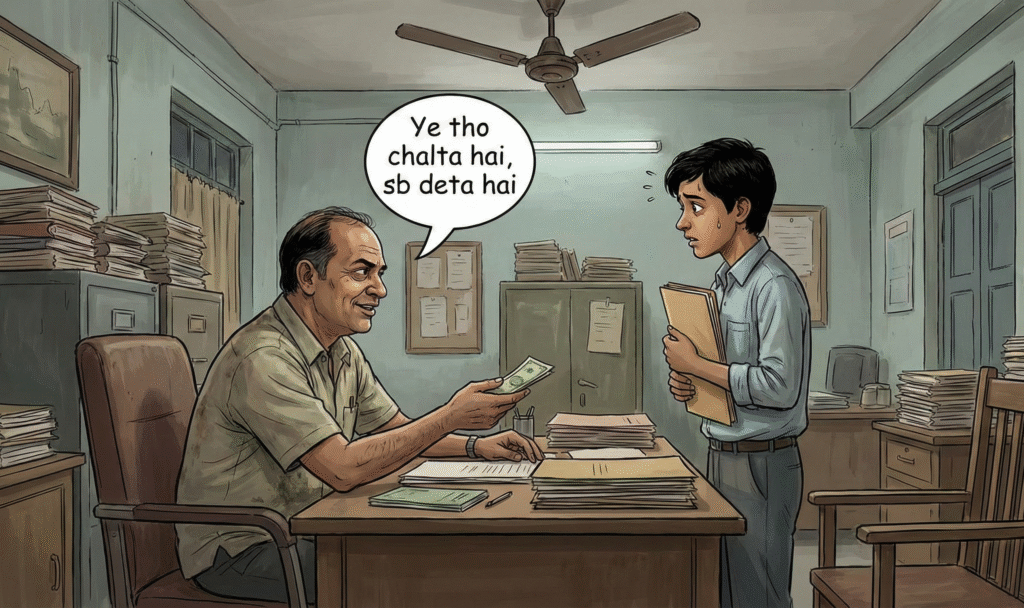
We have all been there. You walk into a government office to get a simple task done—a birth certificate, a property registration, or a driving license. The file moves slowly, or perhaps not at all. Then, the official (often referred to as a “babu”) gives you a knowing look and hints at a suvidha shulk (convenience fee) (Corruption).
When you hesitate, they drop the infamous line: “Arre sir, ye tho chalta hai, sb deta hai” (Oh sir, this is how it goes, everyone pays).
It is easy to feel helpless in that moment. However, accepting this logic is dangerous. It normalizes a crime and turns a right into a transaction. This isn’t “culture”; it is corruption. Here is how we can stop normalizing bribery and use the tools available to every Indian citizen to resolve it.
1. The Psychology of “Sab Deta Hai”
The biggest weapon a corrupt official has is not their power, but your fear of delay. They bank on the fact that you are too busy to fight back. By convincing you that “everyone pays,” they create a false social proof, making you feel like the odd one out for following the law.
The Reality:
- It is not a tip: It is a violation of the Prevention of Corruption Act.
- It is not harmless: Every bribe paid raises the price of public services for the poor who cannot afford to pay.
2. Digital India: Your First Line of Defense
The most effective way to avoid a bribe is to avoid the person demanding it. The Indian government has aggressively pushed for E-Governance to remove the “middleman.”
- Apply Online: Before visiting an office, check if the service is available via portals like DigiLocker, Parivahan(for transport), or state-specific e-district portals.
- Cashless Transactions: Always insist on paying fees online or via UPI. If an official demands cash without a receipt, it is a red flag. Digital trails are harder to manipulate.

3. The Power of the Right to Service (RTS) Act
Many citizens know about the Right to Information (RTI), but the Right to Service (RTS) Act is the specific antidote to delay tactics.
Most states (like Maharashtra, Delhi, Karnataka, and Bihar) have enacted RTS laws.
- How it works: The Act mandates that specific services (like issuing a caste certificate) must be completed within a fixed time frame (e.g., 15 days).
- The Kicker: If the official delays the work without a valid reason, they can be fined, and in some states, that fine is paid to you as compensation.
4. The RTI: The “polite” Threat
If your file is stuck because you refused to pay the “speed money,” file an RTI (Right to Information) application.
You do not need to accuse anyone of corruption. Simply ask:
- “Please provide the daily progress report of my application dated [Date].”
- “Please provide the names of the officials with whom my file has been lying and for how long.”
- “Please provide the timeline according to the Citizen’s Charter for this work to be completed.”
Why this works: An official knows that an RTI creates a paper trail. To avoid answering on record why they sat on a file, they will often process your request immediately.
5. Where to Report Corruption (Without Fear)
If the demand for money is explicit, you have immediate recourse. Do not argue; simply report.
CPGRAMS (Centralized Public Grievance Redress and Monitoring System)
This is a unified portal (pgportal.gov.in) where you can lodge grievances against any central government ministry. The tracking is rigorous, and officials are required to resolve tickets to close them.
The Anti-Corruption Bureau (ACB)
Every state has an ACB or Vigilance department.
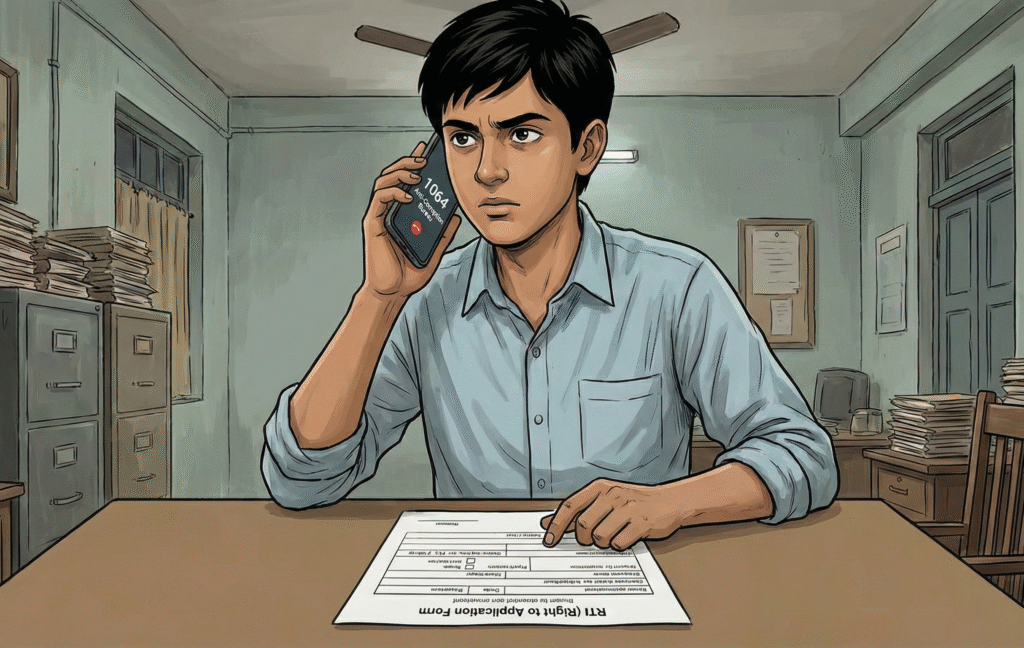
- Helpline 1064: This is a national anti-corruption helpline.
- Trap Operations: If you are brave enough, you can contact the ACB before paying the bribe. They can set up a “trap” where they catch the official red-handed accepting marked bills.
Conclusion: Stop Saying “Chalta Hai”
The next time a government babu tells you, “Ye tho chalta hai, sb deta hai,” your answer should be a polite but firm, “Main nahi deta” (I don’t give).
It might take a few extra days. You might have to file an RTI. But by using these tools, you aren’t just saving money—you are forcing the system to work the way it was designed to. Corruption ends when the “everyone” in “everyone pays” starts shrinking.